


In Kingshot, your individual power is only half the equation. The other half—arguably the more important half—is your alliance. And at the heart of every dominant alliance lies one system that separates the contenders from the pretenders: Alliance Technology.
Whether you are a Free-to-Play player trying to survive, a rally leader preparing for Castle Battle, or an R4 officer managing your alliance's growth, understanding how to optimize Alliance Tech research is non-negotiable. This guide breaks down the three tech trees, the optimal research path for every stage of the server, and the strategies that will keep your alliance ahead of the competition.
What Is Alliance Technology in Kingshot?
Alliance Technology is a shared research system accessed through the Alliance menu. Every completed technology provides a permanent benefit to all eligible members of that alliance.
The system differs from your personal Academy in several critical ways:
- Collective development: Members work together to fill each technology's contribution requirement.
- Shared rewards: Completed bonuses apply across the entire alliance rather than to a single account.
- Leadership coordination: R4 and above officers can initiate research and set a preferred tech target.
- Resource investment: The required materials increase as the technology tier advances.
The Alliance feature itself becomes available when your Town Center reaches Level 7. Joining an alliance early—and contributing to its technology—is one of the fastest ways to accelerate your account progression.


The Three Tech Trees
The Alliance Technology interface is split into three primary trees: Growth, Territory, and Battle.
Growth (Development) Tree
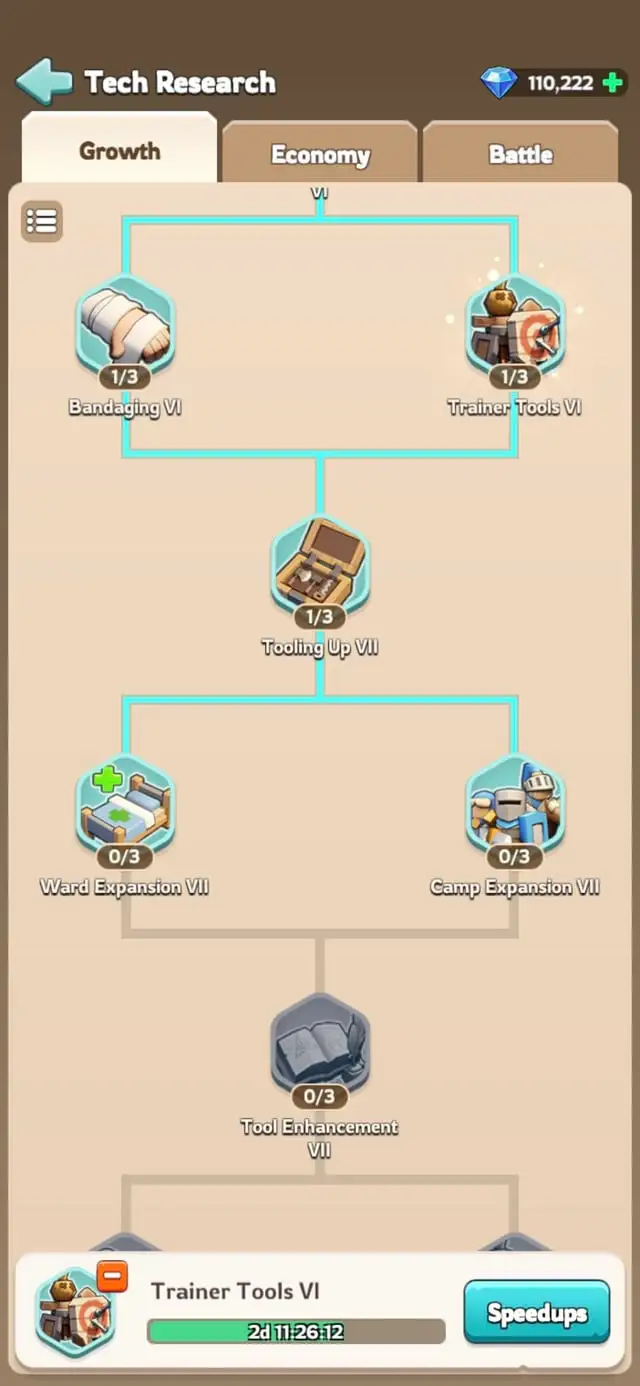
Rule of thumb: Rush this tree during the first 30 days of a server.
High-level Growth tech reduces the time and resource costs of virtually every other action in the game. This is the foundation upon which everything else is built.
Top Priority—Accelerated Construction & Research: These nodes directly compound. Faster build times mean higher Town Centers across the alliance, which unlocks higher troop tiers faster. Adaptive Tools provides construction speed bonuses of up to 5% per tier, while Mechanisms delivers equivalent research speed boosts.
Secondary Priority—Cooperative Protocols & Treaties: Cooperative Protocols increases how much time each Alliance Help removes—up to 150 seconds per assist at max level. Treaties raises the maximum number of helps a member can receive. Together, these technologies are mandatory for the batch healing technique during KvK or Castle Battle. At Embassy Level 30 with full Alliance Tech bonuses, you can receive 30 assists worth 97 seconds each, providing up to 48 minutes and 30 seconds of base timer reduction.
Also Critical—Alliance Regimentation: This technology increases the alliance member cap across three tiers. Regimentation I adds 10 slots, Regimentation II adds 20, and Regimentation III adds 20—for a combined increase of 50 members. More members mean more contributors, more rally participants, and more territory builders.
Ignore Early On: Granular resource production buffs like Quarry and Farm augmentations yield lower returns than raw construction speed. Save these for later when they become prerequisites for other research.
Battle (Combat) Tree
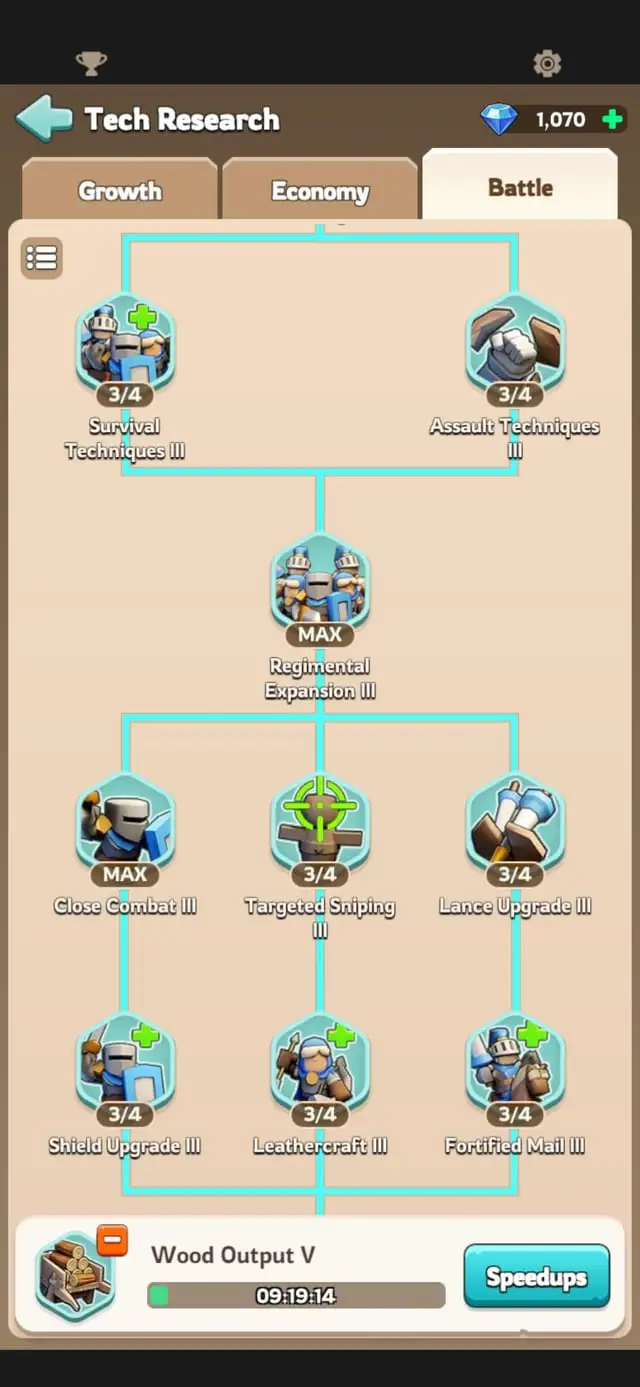
Rule of thumb: Pivot to this tree 2-3 weeks before your first inter-server event or when preparing to contest Level 3 Capital nodes.
Top Priority—Rally Expansion & Rally Capacity: Rally Expansion increases the number of governors who can join a rally. In early server skirmishes, the alliance that can put the most troops on a node fastest wins. The Command Center already determines maximum rally capacity, but Alliance Tech pushes these numbers even higher.
Secondary Priority—Troop Attack, Defense, Health & Lethality: These nodes offer massive asymmetrical spikes when fighting alliances that neglected them. The Battle tree includes separate bonuses for Infantry, Cavalry, and Archer Attack and Defense, as well as all-squad technologies that benefit every troop type.
The T11 Push: As your server approaches the late-game, maxing out Battle tech is a prerequisite for alliances hoping to field competitive T11 Truegold rallies.
The Covenant-Making Endgame: There is a unique technology at the bottom of the Battle tree called Covenant Making I—and it can never be maxed out. This means allies can keep making contributions for Alliance Tokens indefinitely, even after every other tech tree is fully researched. It functions as a system unlock rather than providing a displayed combat-stat percentage.
Territory Tree
Rule of thumb: Level this only as dictated by geographical necessity.
Top Priority—Alliance Banners & Member Capacity: You need enough banners to reach crucial resource nodes and fortresses. Tactical Expansion increases the Alliance Banner cap, while Plains Enrichment and Cultivation Drive unlock the ability to place alliance buildings on Plains and Fertile Land respectively.
Secondary Priority—Alliance Building Durability & Engineering: Durability matters when neighboring alliances can attack your borders. Engineering speeds up construction of alliance structures.
Warning: Do not research the Territory section more than is necessary; the majority of this section tends to be low-value until you actually need to expand. Alliance resources should not be split blindly between tech and banners.
The Optimal Research Path: A Phased Approach
The ideal priority changes dramatically as your alliance grows. Here is the proven research roadmap:
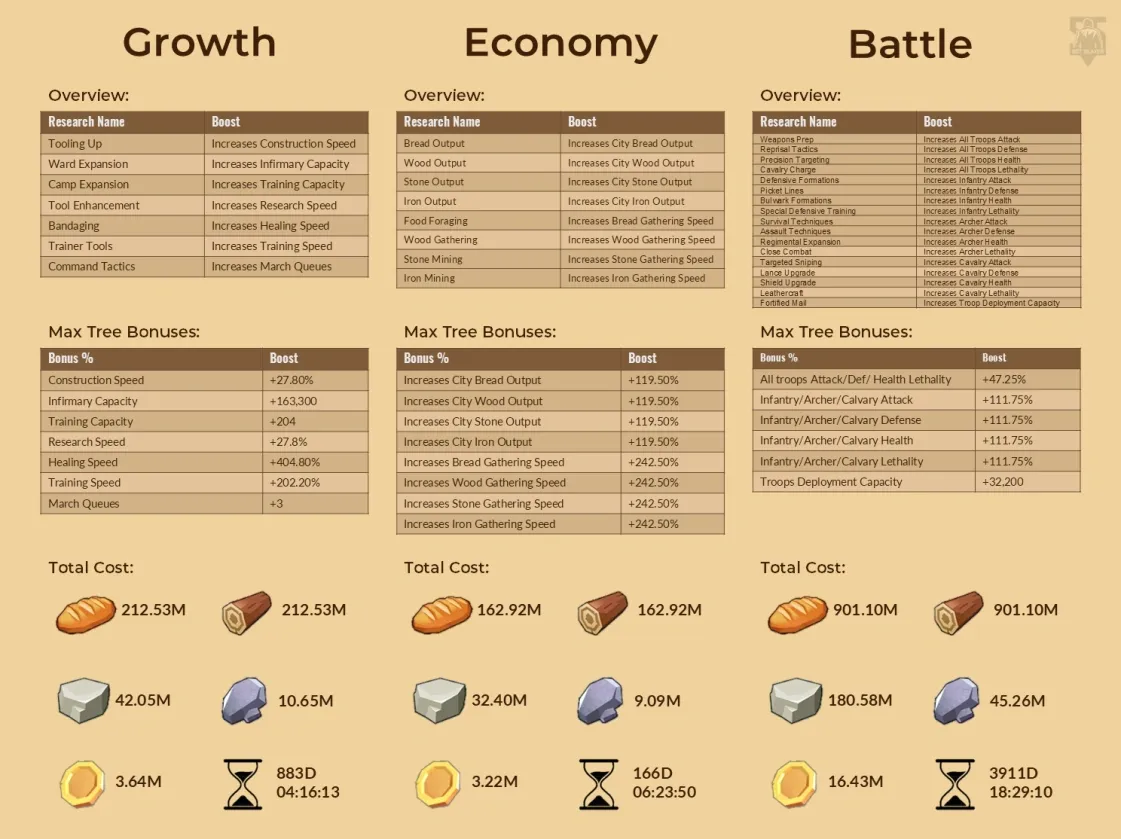
Phase 1: New Alliance (Days 1-30)
Focus: Growth tree, specifically:
- Alliance Regimentation I — recruit more active members
- Cooperative Protocols I — improve Alliance Help efficiency
- Treaties I — increase help capacity
- Adaptive Tools I — accelerate construction
- Mechanisms I — accelerate research
- Advanced Training I — accelerate troop training
The first objective is to build your roster and improve the systems everyone uses every single day.
Phase 2: Growing Alliance (Days 30-60)
Focus: Continue Growth while adding essential unlocks:
- Alliance Regimentation II & III — expand capacity to 50 additional slots
- Plains Enrichment — unlock Plains building placement
- Necessary gathering technologies — Food Foraging, Wood Gathering, etc.
- Alliance Engineering and Tactical Expansion — as territory demands
At this stage, technology planning should follow your alliance's map route. Do not delay Plains access when valuable facilities or resource nodes become available.
Phase 3: Pre-War (2-3 Weeks Before First Major Conflict)
Focus: Shift heavily toward Battle:
- Rally Expansion — increase rally participant capacity
- Squads' Attack — all-troop offensive bonuses
- Squads' Defense — all-troop defensive bonuses
- Squads' Health & Lethality — survivability and damage output
- First Aid Techniques — faster healing after battles
- Rapid Deployment — faster march speed
Keep Infantry, Cavalry, and Archer nodes sufficiently balanced to avoid blocking the next all-squad research.
Phase 4: Mature Alliance (Post-First KvK)
Focus: Complete remaining Growth bonuses while adapting to strategic needs:
- Cultivation Drive — unlock Fertile Land expansion
- Higher Tactical Expansion tiers — more banners
- Alliance Building Durability — during border conflicts
- Higher-level troop Health and Lethality
- Covenant Making I — unlock infinite contributions for tokens
The Alliance Coin Economy: Member Strategy
For the individual player, Alliance Tech isn't just about passive buffs—it's the sole mechanism for generating Alliance Coins.
Alliance Coins are the currency used in the Alliance Shop to purchase crucial items like Advanced Teleports and 8-Hour Peace Shields. If you do not donate, you will not have the currency to move your city during a war or shield it when you go offline.
The Donation Golden Rules
Never let your chances sit idle: You generate donation chances every few minutes up to a cap. If you sit at the cap, you are bleeding potential Alliance Coins. Log in regularly to dump them.
Donate to the R4 highlight: Always donate to the technology node featuring the recommended target—visible as a green thumbs-up icon. R4 officers can set a preferred tech, which gives a +20% reward chance when members contribute to it. Random contributions can delay important unlocks.
The Gem threshold: Using gems for the final few donations can accelerate urgent technologies. However, F2P players should stop donating when the cost scales past 50 gems per click—beyond that, the gem-to-coin ratio becomes too steep.
Resource contributions: Members donate personal Bread, Wood, Stone, or Iron to fill the technology contribution bar. Once the contribution requirement is met and the alliance has enough stored resources, an authorized officer can begin the research timer.
Warning: Failing to donate resources to the Alliance Tech pool is the fastest way to get kicked from a top alliance. Top alliances strictly audit Daily Donation leaderboards.
Leadership Strategy: Managing Alliance Tech
Recommend One Technology at a Time
R4 and R5 leaders should clearly mark one target and announce why it matters. Members are more likely to contribute consistently when they understand the goal.
Research Around Prerequisites
The Alliance Tech tree is not completely open. Many nodes require earlier technology levels. Before selecting a long-term target, check the full prerequisite path to avoid getting blocked.
Do Not Max Low-Priority Nodes Too Early
Gathering, Storehouse, durability, and destruction bonuses are useful, but they provide less immediate value than construction, research, help capacity, or roster expansion. Research them only when they unlock an important prerequisite or solve an actual alliance problem.
Shift Priorities Before Major Events
A technology started after a war begins cannot help during the preparation period. Move toward Battle Tech in advance of Castle Battle, KvK, Sanctuary conflicts, and other major PvP events.
Track Active Contributors
Alliance Technology contributions are a useful activity signal. Consistent contributors help develop the alliance even when they are not among its strongest combat players. Leadership can use contribution activity alongside event attendance, Alliance Help usage, and rally participation when evaluating member activity.
Conclusion
A strong Kingshot Alliance Tech tree is built through coordinated contributions rather than random research. New alliances should first improve member capacity, Alliance Help, construction, research, and troop training.
As the alliance expands, leadership should unlock Plains and Fertile Land access, increase the Banner cap, and improve Alliance Building construction. Before major wars, shift the priority toward Rally Expansion and all-squad Attack, Defense, Health, and Lethality.
The most effective strategy is simple: recommend one useful technology, complete its prerequisites, keep members contributing daily, and adjust the research plan to match your alliance's current growth, territory, or combat objective.
Remember: In Kingshot, alliances that master their Technology tree don't just win battles—they dominate servers.